Bow and arrow and instinct "One day, Drona, to put his students to the test, a mock
eagle mounted atop a long pole.
pupils at his command would have to detach the head from the body with an arrow.
She explained: 'you tell me what you see when you take aim '.
began by Yudhisthira, who explained: I see you, that tree, its branches
...'. Drona .- shook his head and said,' Enough, enough!
Mahabharata, review RKNaravan, 1977. rilerimento talk about instinct in action or behavior that is not directly linked to self-preservation and reproduction, and the perpetuation the species, it sounds weird.
In nature, instinctive behaviors, those fixed forms that characterize the species of animal (and human) are genetically determined in a direct way. These
affected in a limited environment and its influences. There is a portion of behavior that is not genetically transmitted and that of the learned behavior, a phenomenon very "cultural".
In this case, the genetic control mediated primarily by the ability to learn and secondly, if they exist, from the learning channels that orient to certain stimuli or confine within certain time intervals (see imprint).
Here, in the case of learned behaviors, Analysis should move the target from the event to its behavioral determinants reasons.
The great chain of human activity in which the instinct (in the broadest sense) directs the game is composed of systems of action-reaction coming from the legacy of prehistoric human activity in which the animal was rather than rational behavior by all those artificial which are shaped according to adaptation to the environment during evolution. Instinctive behavior,
directly influenced by emotions, is a language that speaks to us from the depths. Some events are instinctive for us usual, as some reactions to danger and to protect our progeny, the mechanism of courtship.
But the chain is also made by rings made of events in action, the environment and property, many of which have gradually weakened with the impoverishment of the senses (which were at the dawn of our evolution the animal component more valuable to the defense and hunting) and only some of them occasionally emerge in us.
happens when they leave us stunned and confused, often disoriented. The differentiation between purely instinctive and acquired action for adaptation to the environment, and its changing circumstances, which gradually becomes natural and transmittable, often fades as well as its meaning. We are in fact hybrid animals.
pure instinct you can only see one of the beasts, assisting with a leopard cub that exercising at a hunting "large" while his mother watches him closely and observing the many miracles and actions that appear in nature documentaries.
For a hunter's instinct is to reclaim part of that, to compete with the wild
, the lost dimension that allows the dehumanization necessary to its relocation in nature and the environment.
When is a component becomes instinctive, in other words, when it happens that a pattern of actions developed as a function of baseline need to become instinctive techniques to shareholders with Transmissible genes? On this front, we still know very little. However, it is possible that certain attitudes of adaptation to develop a mechanism of natural selection in which the holders of the solution to the problem (and therefore survive) tramandino to their posterity those skills / abilities that enable them to survive in the environment or to turn his adversity . A sort of adjustment to the genetic predisposition to learn, which can also be lost once the environment (and the selection you are} amended and no longer requires these characteristics.
The philosopher and anthropologist Bateson speaks of two categories of behavioral mechanisms and active production that can reconnect almost all human actions: the calibration and feedback.
are both on controlled by the brain and produced by the body, both acquired from the input and both cause a reaction in our muscles in our actions. There are therefore two methods of improvement of adaptive action. In our case, we see in the report related to the strike from a distance.
calibration.
calibration results from the analysis in the strict sense of the senses and the instinctive part of the brain. In practice it does not analyze the processes one by one, but is expressed in a reaction that is often a direct action of the body very quickly.
is gradually refined through practice, repetition, with the unconscious assimilation of the variables. The key feature of this Calibration is the necessary training time to ensure that it become effective, error-proof (only on a large number of mistakes it is to establish a valid calibration process), but at the same time will be extremely adaptable to different circumstances and can achieve amazing goals. Its only limitation is the energy required to be used to obtain adequate experience to avoid mistakes. Learning a manual activity is something like a sort of gradual unconscious meaning of an operation repeated several times.
The carpenter nailing boards in an efficient and ergonomic advantage of a workout because of thousands of repetitions and corrections, but does not think raises the hammer and hits the nail. We can not speak of carpentry instinctive, but if the carpentry in the very long time to become a key focus for the conservation of the human species, individuals do not survive the carpenter carpenters and then probably become a transmitter of selected genes. Instinct for its future generations, individuals would be able to drive nails with a reduced training due to genetic predisposition to learning the art in
well-defined time windows.
We are faced therefore with natural activities (the place that does not require the use of reason), some of which may become part of the genetic heritage of transmissible instincts, instead of other lower category that do not. A process
sure instinct, and then calibrated and walking: the child, when he stops walking on all fours and learns to walk at two, he does after falls and slips. The child, growing up, instinctively learns to walk. Although his parents help him, in fact he does not have a great need, they do not teach him anything. The ontogenetic mechanism is alone and is suggestive as it duplicates the phylogeny of primate hominid bipedalism that makes her, in a very short time.
feedback.
Feedback is a process governed by the rational component of the human brain. Generally mediated by systems mechanistic and units, which are helpful and often become the backbone of the mechanism in which the rational mind to acquire a given time has the need to process information in a linear process (the starting point must be uniquely determined as well as the boundary conditions) and leads to the result by a correction of progressive and accomplished in small steps.
The accuracy of the results obtained with the feedback is very high and depending on the amount of variables involved and the precise knowledge of them. The feedback system is scientific and "Galileo" to all intents and purposes identified parameters, the process can be replicated and the result is virtually guaranteed. The feedback to
human activity, not animal, because the result of a cognitive mechanism entirely governed by reason.
But what does all this with archery?
Today, archery is practiced in two ways, of course, fundamental to the outside there is a glorification of technology: arches dating of pulleys (the compound) that greatly expand the effort is intended to allow a more comfortable, along with devices
sight (sight pin, sight and Visette) that allow an alignment (after appropriate calibration) can in the center of the target without knowing the distance. The other form, called instinctive, is followed by those who love traditional equipment, basic and primitive and admittedly it does not happen with collimation (no viewfinder and the other trappings to facilitate or induce). In effect, the controversy which can be observed on the race tracks and rallies that provide for both specialties is often what is expressed by doubt, sometimes legally, that whoever takes over the target in all respects with the tip aimed the arrow on a false purpose, with some other bizarre combination of external references in the center of the target you must hit. It comes to style and borders on moral philosophy. The "pure" disdain the charges to target. In the voltage is only competitive race, the anxiety for the comparison with others. The
target is a sheet of paper or a three-dimensional shape in the shape of wild, distances, even if unknown, however, included in a range that goes from 5 to 50 meters, are proportional to the size of life corresponding to the maximum score achievable. The evaluation of the distance, if you aim with the bow technology (0 for those who "bara" and seizing references coincide with the tip of the arrow), is critical only by virtue of the score.
In hunting, the situation is completely different.
First of all the distances are smaller, and many more, on average, then the voltage is extremely high and more opportunities for the bow are monstrously rare. Emotion is a funny thing. Evidently, the feedback mechanism is the shooting as those specialties that involve objective aims, the goal and collimation. Human intervention is a recurring weapon-target object. The first hit leads to a result, by which humans modified instrumental apparatus target or setting the structure, up to the (system calibration) of the target in its center. Getting in the race with well-calibrated equipment and a proper training is essential.
The error to be corrected (the information that must be used) is the difference between the aims of the viewfinder system and the direction of the target, the greater the severity of the correction factor (function of distance and mass of the arrow). In practice this adjustment is the key to hit the target in situations similar to each other. Still in training may be that the athlete often have to travel this circuit: receiving the news of the error, fix it, receive the news of a minor error 0 zero and finally release the arrow.
In this way, the archer, in the calculations is aware that the next round, does not report news or information about what occurred on the first lap. The only information is the error on that specific point. He does not need to change himself.
calibrated mechanism is completely different for the archer to aim and release the arrow unique, does not have time to correct your aim before release.
True-strain-release is a single action, whose result (target colpiùo to no) information must be reported as the next shooting. And the whole operation must be improved, the object information is then the whole operation.
The new shooting the archer has to calculate (and does so unconsciously) its action based on information about the location of the new target and on the experience in previous shots, and especially on their outcome. The differences between the shots made and their results are kinesthetic stimulation needed to face new situations of fire. The refinement of perceptions (Environment, light, contrast, wind, height differences) and refines the shooter makes it effective, the price of such training.
In summary, archer aiming simply runs its course cybernetic a number of separate times, and who instinctively pulls must gradually acquire their skills to build, introducing the subsequent experiences in
those that have already been made. Every shot is the product of a "new archer, calibrated by past experience. The traditional
shot was created with the traditional bow, that is simple and essential part of prehistory and the beginning of history. The vision that makes her how to shoot instinctively, sometimes misleading term as it is seen.
To analyze how there can be a model of instinctive shooting calibrated, you can get lost in a sea of \u200b\u200buncertainty. In effect, from what has been written, the instinctive shooting is a shooting holistic tout court that involves the entire body from the kinesthetic point of view, which does not break the action in separate stages on which to act retrospectively, which incorporates in itself the machine (the arch becomes a means of propelling a bullet, replace the arm that throws a stone or a spear) and is optimized with a lot of practice. The adaptation of the body-propulsion system, combined perceptions can (proprioception) buoyancy adjusted in subsequent documents stored in the memory of gestures, identify it as a process of recursive self-learning how to walk, run to work with their hands on the matter. Then call this
archery "instinctive" is perhaps an exaggeration semantics, but it suggests the immediacy with its essence. It could be discussed as part of the prey instinct heritage of our species and II as well the "strike at a distance". In this respect, shoot the arrow with the body without the intermediation of reason that takes advantage of corrective feedback, with practice on their mistakes, it could barely be seen as the extreme development of the predatory act consistent with the behavioral expression hunting.
No objective it seeks
The calculation assumes instinctive shooting The absolute lack of aims and means of objective assessment of the futility of shooting distance.
The arrow makes a parable, however valuable in its way. Associate the correct assessment of the distance of the target we mean a real ballistic calculation. If the distance is beyond 30 meters, the going gets dilficile. But among the postulates of the sacred bow hunting is the lemma which prohibits absolutely upper distance shots, and then the whole thing is simplified. At 20 feet, optimum distance to target, the trajectory is almost a straight line. The aim of preaching instinctive shot with his body, not just eyes. And then sensitize key
sull'assetto body and not be tied to patterns of academic burden "school."
The hunting ground is always different, you will almost never support a smooth and flat. Here it becomes important to be flexible, as a fundamental axis sensing the shoulder joint that is configured when you bend the bow.
II arm of it, the hand that supports it (not squeezing), shoulder and forearm on the side of the cord must be rated by the gun carriage to the dock to set the correct action. It must always be dynamic, perfectly smooth and expanding. No matter
absolutely stuck in aim, because you have no viewfinder diverge. So how do you take? Simple. Just focus on the smallest portion of the visible target and fire.
Certainly the first time the results will not be glamorous, but the computer inside, calibrated the mechanism, gradually acquiring the information specialize gesture. And still fundamental to focus the action on the vertical plane, that emphasize the dynamic action-forward back in order to keep the correct level of force. This reduces the errors on the horizontal and scattered, only to top-down. If you set gid well, you should have already known this. This, in other words, it means that the only obstacle to be overcome related to the different distances to be covered and Training with your inner computer does the rest. It's just a matter of practice. The distance limit of 20 meters in actual hunting is important precisely because it poses special difficulties ballistic and heavy hunting arrow, with any hunting bow is thrown properly, will still have enough energy to penetrate the tissues to cause injury.
In simulated hunting for fun, we go much further and Papua up to 40-50 meters can also get a good grouping of pink can a good workout. In competitions such distances are common and it is extremely useful to alienate even greater distances. We
renderfi account rapiùamente importance buoyancy in the vertical plane and delfimportanza follow-through after the shot. On this we will return later.
setting body
An important detail: the upper body tilted forward as well as parallel arc. This will allow a very clear vision of your surroundings and there is direct communication with the diaphragm bersag1io without visual arc of the window (this is inevitable when you keep it straight).
Remember that the balance of posture is essential, and always be sought before setting the fire. Do not sacrifice energy for training, to discover the best set. It will always be what will allow expansion and effective control during and after release.
This style of shooting can of course customize it to specific anthropometric shooter. Call instinct can not be enclosed by a single scheme for all. The secret of its effectiveness is in its ability to adapt this, which takes as a fixed point of the dynamism and fluidity.
This much-vaunted dynamism thus reflects another of his specialties powerful: the speed of the shot. Pull quickly and repeatedly is part of the background of every hunter in simulated real-respecting. To achieve this it becomes even more necessary to train to shoot while fixing the concentration at the target, never taking. The operation
NOCK, a prelude to the shooting, has to become automatic and assolutantente no effect on the flow of action, aiming to hit the target. That makes it evident that it is necessary to learn to Nock the string but not looking ahead, toward the target.
To make this style your face there's nothing more exciting as the training of hunting simulated three-dimensional shapes and moving targets. But wandering through the woods, pulling fallen leaves, dead branches, spots of light (the classic roving) that for decades has been the best way to train off-season, is a great way to test your preparation before you take the field . A workout
can be extremely profitable implement casting distances, absolutely fantastic. This can be useful to be aware of its influence in on the act of shooting, in other words, close up, concentration and relaxation necessary for the good shot is often tainted by fear of attack and the act suffers a disruption that block the natural flow.
take over contempt and insecurity factors (such as not be sure you are aligned, the fear of surrender, to look bad in front of friends, etc..) Ruining everything and the automatic control of the gesture should be to hell because the rational brain takes over instinctive trying to analyze and correct. Unfortunately
our analytical brain can consider only one process at a time and over time, albeit brief, analysis of the entire chain of natural actions and reactions are inhibited.
To realize this, of course, the cure may be the shot in the long and very long distance.
If you put a pole at a hundred paces and try to steer the arrows impaled against a can of beer on its top, facing all as a game and your reason will be "a reason" for the fact that your level what is requested is beyond the human limit. You will be much more forgiving with yourself and with your doubts and uncertainties.
Tirerete just maybe a good time enjoying a flight of arrows integer that will last for at least two seconds.
Well, you pull too many arrows in freedom. Then go to fieldwork. Very unlikely to have fired the can, but not stupiùevi if one or two arrows have colpiùo the pole nearby. A miracle!
Do more. Try the two arrows on the ground further away (in the horizontal plane) scattered right and left and measured error. Probabiltnente be two or three feet, not more. Now reported this error to the distance that normally pull: this difference, compared to the classic distance at which you practice, corresponds to an error of a few centimeters more or less from the center. A very small difference, if you think the days not so fortunate few meters from where you make mistakes capiùa support of the target, or nearly so. Here's the answer: in case your computer relaxed interior perfectly handles the whole situation, and can make homes much larger than those supporreste. Clearly, the fact of knowing it will not cure your disease in a flash. But will point a way, anything but pessimistic, to be followed to solve your problems. Let it flow
instinct for a good time to park the arrogance of reason, and I surrender to the physicality of the act without comparing themselves to any model trying to be, not just appear, it is an interesting recipe that stress true not only for archery, but expresses its power in a very immediate through the application of this ancient discipline ... instinctive.
If you really manage to make you a reason, you will realize that they have everything you need and we have made a major breakthrough in terms of self-esteem and confidence. And that's what counts most.
The follow-through, this unknown
Tugging at long distances is more easily discover the mysteries of the follow-through. In fact it has always been explained in a rather cryptic. If you read on most instruction manuals chapter dedicated to him, it seems that between the phases of the shot, taken rigorously examined (posture, nock, tension, aiming, release and follow-through) ours is a kind of "ritual figure," a compelling final force required for self-examination of the conscious and the arrow runs toward the target. All this made the arch can still vibrating in his hand, the eye that scrutinizes the impact of the arrow, the hand of the rope gently on the shoulder relaxed.
To many students, indeed, everything is ordered, when he still can not understand the meaning because they do not fully able to organize coordinated action of the shot and when to shoot their arrows in series one after another in an attempt to drain quickly quiver seems the only unconscious goal to pursue. Well, this is the striking example in which the case is being confused with the effect. The follow-through occurs when the action shooting, which took place in accordance with the plans for the force, took place in the best way. It happens all by itself, when the concentration of those pulls is likely to "push" the arrow mentally throughout his dish to the center of the target, when the energy of the archer (not just the muscle) is projected in the act of wanted to hit the mark. It is therefore not a "bound set" of the sequence of the shot, but a direct consequence, the outsider, an action well done. To try it, the mental representation, idealization can really drive the arrow in its flight with the power of the mind after the issue is what is needed. From the outside, viewers will see a perfect follow-through. [1] Bateson, G. Mind and Nature, Adelphi 1993; Mittelstaed, The analysis of behavior in terms of the control systems , New York, 1990.
Down the error: Notes on the Construction Staff in education in archery hunting the killer These notes are not talking about racing technique, but of basic education. One of the most common troubles that afflict the society is the flight of archery archers after the first months of activity, in most cases due to a tendency to relegate to the standard imprinting little motivating, or worse, to the neglect of those who work for teaching.
The experimental work done by myself and Edo Ferraro, Coordinator of the Education FIARC in recent years turned towards this direction in an attempt to overcome this problem. And we think, in light of the results that they have got their hands on something important. Presumption aside, the logic of this "revolution" are interested to our dear old first basic course, and probably will evolve into more advanced stages of learning. It is inspired by a still teaching in the "experiment" but well known in the ' science teaching called "constructivism," never applied to the field sports and athletic disciplines. We come then to the point.
First is to make it clear that the time sequence of lessons is not scanned in any way by "steps" of problems, arguments or steps obbligati.Il usual basic course, which included lessons in the lineup (the feet of body axis shoulder arms, hand bow, bow arm, hand rope, release and follow-through) is now seen in its entirety, without these steps canonical "espositivistici.
The concept that must guide the instructor is the one that sees the expansion plans of force as the only objective to be achieved for the shooting technique, leaving details the interpretation of the covenant which gradually discovers own way that is most suited.
This is not completely deny the past, which has seen a detailed education in the canonization styles, sequences and phases of shooting, just simplifying the problem, with the sole target for learning "movement" in its entirety, and goal essential reach to raise awareness of the 'student towards an understanding of the concepts "power plan" and "dynamic expansion." In effect, these are the only fundamental and common points between all styles of shooting effective, regardless of their particular variants. Problems related to the loading of the arc (Levers, vertical, horizontal, bottom, top, power archery, etc..) Are secondary and accessories. It will be the same student to choose.
Split classes for subjects not seem particularly advantageous in light of the foregoing. Each student has a "relative time" learning scanned by discoveries related to its sensitivity and motor experience.
In other words, the first lesson the instructor must:
1) observe the student to his first pitches, trying not to influence it in any way with words and live models, this is because the motivation that led him to enroll in the course requires the embryo of "ideal model" for which, one supposes, he is very willing to fight to represent the best;
2) to study the attempt to "represent the ideal personal identifying the main obstacles that stand to achieve the objective, which in essence boils down to mastering buoyancy along the planes. In this attempt is probably contained an array of not entirely wrong, which should be encouraged because it optimizes the fullest.
What are the judging criteria that allow us to say that this matrix is \u200b\u200bto be optimized?
simply function as such is close to an ideal model in which the plans are met with a strong movement in expansion. This is the basic premise.
From this point on the actual teaching part of the "Building Staff." The personal construction based on the assumption that any kind of knowledge should not be "transmitted" from master to as good or evil has been any kind of teaching we have been experiencing so far in all fields (Espositivismo), with a teacher, that is, shaping by forcing the student to learn concepts and models. In this way, the knowledge remains stuck at 'outside the sphere of their knowledge and do not take root, if not with much effort, in depth (this effort is one of the first leaders of the many dropouts).
The teacher tries to uncover the pupil idealization of his own discipline, inspiring in bringing his personal interpretation which already partly owned by an idea at the start and that should gradually refine.
In this way learning takes substance, not be forgotten, and especially gratifying, because it's basically made just by the student. The teacher should encourage the student in order to highlight and possibly anticipate the obstacles that he will find the path, and will be the same student to propose solutions that do not involve the observance of any preconceived dogma and gratuito.L 'expansion along the plans of corrective force is the only "dogma" to be met, but it is a natural condition of optimization of the gesture in ergonomics, and instinctively (experimental teaching experience) it is contained, albeit in a more or less latent in every allievo.La figure blurs the image of the teacher who requires a learning path in predetermined steps, becoming a fellow (more experienced) of discovery, offering different paths until the most rewarding journey of self is formed by the alliance.
he "built" in first person what the most rewarding.
As for our specific discipline, the archery of any label, some arguments can not be resolved without the use of traditional teaching mechanics (such as safety rules!) but it works so extraordinarily effective, and can be expected, especially in the beginning, a sort of personal construction and method in which traditional teaching ( Espositivismo) walk together.
Teaching needs to be set in one direction and then through a flexible student-instructor dialogue continued, where the first "proposed" experiments and the second executes them by commenting them as deeply as possible.
From this dialogue, the instructor must learn to propose ideas for different situations gradually emphasize that the canonical obstacles that the student will find its way discoveries. In adhering
can never be said that what he does is just wrong, but these exercises should be proposed for which he receives, for example, instability, tension and discomfort. Its no longer be "mistakes" and then, but difficulty in overcoming obstacles. The task of 'Teacher, we repeat, must be to emphasize these obstacles to make them more insidious and less obvious, and therefore more easily mastered by the pupil himself.
not ever have to give the answer to a question. It must look to the student, and help in the search and once found, conceptualize. It will be necessary, clear, face an obstacle at a time, organizing questions and exercises with situations that could undermine the idea that motor or attitude to impede the acquisition of the student movement along the expansion plans of corrective force. How well the student must learn to "feel" in the movement, to perceive more deeply, trying to work on his feelings immediately bringing it to focus on the obstacles. All this keeping in mind that cognitive processes and the speed of learning are obviously not the same for everyone, and it is necessary to comply with the starting levels (physical, cultural and psychological) and the individual speed and capacity self-analysis and structuring of its motor and conceptual model, real personal filters through which we learn and we interpret reality. It should not be raping anyone.
What are the "problems" immediately emerging from wanting to apply this method? surely the difficult applicability and understanding of the instructor used to teach in the traditional way. In our training courses for instructors are qualified to FIARC the old canons, there is more to the great variety of reactions. There are those who staggers, rolls his eyes, he was seized by illness.
-Like, I do not have to correct? I must observe, keep me in lowering the shoulder of the arc pupil that pushes up, and what do I propose? - instead there who (and here's to worry about) not even a nod, saying with authoritative security that he had already discovered, and always understood, always applied the shock and amazement that the other colleagues.
Very often this misunderstanding. The real difficulty in understanding the method lies in the denial of a model to be followed slavishly, any model like the staff that the instructor has gained after years of hard work, and also that of Olympic champion. Reduce the model to two simple and fundamental objectives, the plans and the strength of the expansion, is a simplification elegant but requires extreme technical maturity and expertise in applying it, and a lot of courage in the "remove" their deeply held convictions made in years, accepting the interpretations of the student even if they deviate from the usual canons. It takes maturity and a desire to return (and recover) in question. Unfortunately they are not common plants in our backyard. Dear Instructors, have your say. Any exchange of experience is valuable, and these lines just want to stimulate a dialogue.
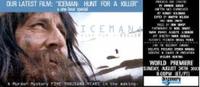 "Iceman, Hunt for a Killer" is the sequel to one of the best and most award-winning documentaries on Otzi, ICEMAN, released in March 2002 in the U.S. and on the cusp of discovery stuck in his left shoulder, then recently. Brando Quilici , son of Fulk of documentary art of memory, had the idea to make a documentary in color "yellow" and the environment with art laboratories and forensic pathology in that of Bolzano, where it is jealously houses the mummy. If first emerged in the fascination of scientific discovery (think, after more than eleven years!) In the second documentary, the aim was to investigate the possible circumstances of violent death, inspiring a lot of questions and hypotheses. My operation advice, as you can imagine, was that relating to the reconstruction consistent archery equipment, the problems of the hypothetical ballistic weapons and shoot on the reconstruction of the culture of the copper, in other words a process of reverse engineering can be assumed that the circumstances archery which have resulted in the death of our subject. All this in collaboration with the University of Trento Annaluisa Pedrotti, member of the scientific archaeological iceman, which since its discovery there has worked continuously and Egarter Vigl, the curator of the mummy.
Yellow is exciting. The data are numerous, but difficult to interpret. Many of them likely to emerge from future investigations, but already now it is possible to deduce logical interpretation, or at least rule out some hitherto considered possible. The
having to recreate, for a science fiction the possible circumstances of the attack and the fight was a very memorable experience. I dare say an "experiment" conducted archaeological without saving. The crew of the Discovery Channel and Brando Quilici Productions (more than fifteen members) has allowed the use of professional actors who acrobatically "played" the possible situations in weeks of continuous operation. The scenery, at 3200 meters high (obviously not turned the real place of discovery in order to avoid any possibility of pollution) in area and at the next like the killing site, has made an extremely realistic and has enabled us to "suspect" a series of hypotheses and testing of dynamic hard to evoke desk. I hate to think the effort of the poor (!) And other actors cinecittà enrolled in Val Venosta, formidable professionals dressed with extreme care, skin and reconstructed facilities, which have been heroically our requests and dozens of repetitions and reworkings of scenes and action that gradually there came to mind. In the documentary, there was also attended by two good archers FIARC of 06 Alps, who participated in a simulation of technological equipment with fatal shooting at long range. Their trial has demonstrated the difficulty of shooting at high altitude, rarefied atmosphere and wind on the ridge. Of course, the documentary shows a very short spot of these actions, the logic in a spectacular way to expose the possibilities and commenting on the degree of scientific probability. The implementation of some complex scenes has allowed me to see and participate in the difficult world of filmmaking, special effects and stunt filming. My job was to train underground actors likely to use weapons of Neolithic, axes, knives, spears and bows and arrows, of course. A frenzy of deadly arrows (in the scenes spectacular reminiscent of the fight) and close combat, can not deny that the study of the backstage film by Nils Gaup, Howard Hill and Kevin Costner I have been very helpful.
times Otzi, the Cultural Revolution
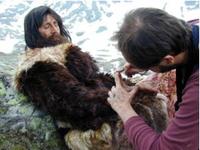 A corollary of the script is the strong theme of the Neolithic cultural revolution, whose effects are more than the current time of Otzi. The transition between the human hunter and gatherer to the culture and agricultural produces an increase in violence among humans very evident, 5:00 to 6:00 thousand years ago man began to fight for his property and the hunter accustomed to the use of his arms, he becomes a warrior. Born (and this is confirmed by the sudden amount of evidence of massacres and violence in previous eras did not reply) private property, social order, hierarchy, and therefore the envy, greed and despair. So, comes the "civilization" modern. It 's very simplistic, perhaps demagogic, boil a phenomenon so important with this simple sentence. In fact there has been change, due to population growth (thanks to a wealth organized food) and the stabilization of the settlements that are starting to brand themselves as protected villages, fortifications bulwarks, and then to a potential attacker. First of all, surely this man was living with a greater balance between self and nature, was nomadic and flexibly integrated with climate change and the movements of the game. A little 'as the American Indians before the white man, who refused the concept of land ownership and game. But it is impossible for a new science of archeology to provide absolute indications now needs to proceed with extreme caution any investigation and conjecture, to avoid ideological simplifications. The documentary
wanted to emphasize, however, this drama, as a prelude to the emergence of a humanity that - do not forget - has allowed the development of progress. 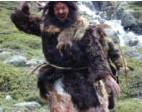
Speaking of the main theme, the scenes of the hypothesis of the death of Otzi subsequent chase were very interesting. The theory of the "lizard tail gambit" that explain very well was re-created, as well as those of close combat with the knife (replaced only in the sink in the foreground with a reproduction of an early plastic) made me tremble, not for fate of my blade of flint, but for the wonderful professional nonchalance with which these actors if they were waving in front of the face and another jumping from a rock!
theories about his death
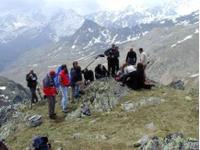 The documentary sought to summarize and reconstruct the possible circumstances of the killing. Many doubts and misgivings, therefore, but a lot of stimuli to meditate. Things really certain there are very few, and it is difficult not to get lost in fantasy. The
Otzi's shoulder injury could be sufficient to legitimize the idea of \u200b\u200bthe fatal blow, even if they are well-known cases where people suffering from bullet slow survive for long. One such theme is the Kennewick Man discovered in North America, dated 9200 years, with a spear stuck in the pelvis but is surrounded by bone tissue regeneration, or the woman 11,000 years ago the Grotto of St. Theodore, in Sicily, with traces of lithic projectile (probably a arrowheads) hit in the side and still survived the wound for a long time. Again the callus testifies. My experience of prehistoric hunting equipment, and those of bowhunters are in contact with which may be useful ... but to a certain point (I have not experienced a specific battles between humans and on this front ... fortunately the bibliography is poor ). The impression I get from the wound and the penetration of the arrow, compared to similar situations is the wild, however, that the wound might be or become fatal, even if times and circumstances known today are not able to support a verdict secure. In our case, these data are: the arrow has penetrated the tissues of the jacket and the shoulder, the scapula has broken through and stopped a few centimeters from the lung. Probably (and this will ensure the removal of the tip) the cusp severed tendons and an artery or a vein, and this can only mean the paralysis of the left arm and one death for progressive bacterial infection or rapid bleeding. Surely, the wound was very painful, caused a strong bleeding and a gradual weakening. I think very unlikely that Otzi was able to break the auction alone, given the position, and especially the extreme painfulness of the injury. That has not been found no broken auction close or it could mean a fall during his flight (I dare not think of the pain consequent) and a consequent loss of the auction to another place, or give rise to a divergent interpretation of the car mechanics: if the arrow that Otzi had been hit compound, with a distal foreshaft similar to that found in the quiver, the posting of the auction would have been possible with less pain;  or the hurry of flight movements could have caused the gap automatically, as often the case with hunting in the wild. The reason to build rods with foreshaft is precisely to promote the recovery of the auction, leaving the tip and the distal small stage within the tissues. Making a rod straight and surge is much more difficult and time consuming (and therefore uneconomic) to build the spire and arm them with a foreshaft. Hence the need to recover the surge shaft. If an autopsy analysis of tissues removed will detect traces of different wood connected to the cusp (usually foreshaft is made with a harder wood that used for the auction) as dogwood or even the complete two-stage auction found in the quiver, we may have more clues that might suggest how the auction is a different quiver of arrows directed to Otzi and he has recovered during his drain before using it again later. Before the discovery of the peak in the shoulder, the assumptions about his death was related to three different theories: the most "excommunicated" today is the one that saw our tired from the long climb of Tisental fall asleep exhausted and be caught by a sudden and heavy snowfall. A death by gradual loss of the senses and the next exposure. The other went a stampede from the village and aggression (because of the weapons found unfinished and fractures to the ribs for the supposed right of the first X-ray Austria) is now partially re-evaluated. The first scholar who tried his hand with the mystery of Otzi, Konrad Spindler, in the proposed His scientific publications and was popularized in the book "the iceman" published in 1993. Professor Spindler, assuming a fight or a fight anyway, even if it was based on incomplete or incorrect information without knowing it, he sensed something very close to the truth. Other
(especially Johan Reinhard, an expert on South American mummies) hypothesized a "ritual sacrifice" to justify the fact that our ice man, apparently a leading figure in his community, was not stolen anything, especially the valuable copper ax . Today, in light of the discovery (and following of his injured right hand be interpreted as a stab wound to lytic Because of its irregular profile) to combat the violent death seems the most likely. It remains to interpret the condition. To summarize the most significant opportunities, the first one is an injury hunting accident. An ill-advised shot, and concealment of a corpse by the hunting companion guilty of negligent murder. Obviously it could not take home the things that Otzi.
seems to me weak (in the light of the perfection of the shot and other wounds on the body) but we can never exclude it.
The second assumes an accidental injury: Most of the allegations of otziologisti overseas about the possibility that Otzi was accidentally wounded by his arrow. One of his fall, while extracting the arrow, or the arrow that pierces the quiver is given and the victim's back. Archer and hunter, I think it is absolutely fantastic that an arrow "accidental" can pierce the thick fur coat, break through the scapula and penetrate deeply through the muscles of the shoulder, especially being in the position as it has been detected. Imaginative, though perhaps virtually possible. Experience as a modern hunting arrow (and those with the cusp of flint are certainly not less) can be dangerous if handled clumsily. A flight from an ambush on the tree (the tree-stand falls are the most common causes of hunting accidents in the U.S.) with the arrow over Nock can certainly be dangerous, but assume a scenario similar to the Iceman seems very risky, because of its characteristics would be found the first case of its kind.
The interpretation of self-injury in water on all sides. First of all because, as we reported previously, who examined the body of Otzi has discovered other injuries hurt, and the scientific evidence that they are considered fully consistent (and forensic scientists know their job). Gradually, the hypothesis that violent death has become increasingly realistic, Egarter found several wounds on the body, which reinforce the idea of close combat. The deep cut on his right palm and other bruises (not initially identified or attributed to damage of thawing and post-shipment) are classically defined as puncture wounds and cutting "autodifensive" against sharp weapons. Subsequent interpretations
also plan to violent situations: the stampede from the village attacked by enemies or predators, chase, injury and death in a hidden location (and therefore have to predict the recovery kit) or the murder by another pastor who wants to take possession of the flock of Otzi. Our severely wounded flees, hides (and hence ax is not stolen) but dies for injuries and the sudden drop in temperature.
A variant, significantly, describes a scenario is quite articulate and charming, "lizard tail gambit," as it is called by the U.S. led by Petr otziologisti Jandacek, is the theory that sees our attacked by a villain who wants to steal the precious ax copper, he is wounded in combat, being chased and then shot by the arrow, but still able to resist and escape planning a defensive strategy. Much like the chess-like strategy (the gambit of the lizard's tail, in which pedestrians are sacrificed to improve the defense and counterattack), he spreads some of his things in the vicinity, bow, quiver, backpack and precious ax as bait. Takes with him only his knife and birch container with hot coals and hides covered with snow, perhaps leaving a small glimmer of vision. The attacker, however, does not find it and the bad weather arrives. Otzi falls asleep and died from his injuries weakened into a stupor, freezing.
I believe that imagination and creativity might suggest infinite variations to the drama dell'Ötzaler Alp. It will be impossible to determine the true circumstances. The one thing (or at least there is no other evidence that might lead one to suppose otherwise) on which you are obviously working, it is his arrow wound, and on that, analytically and scientifically one can speculate. (VB)
The arrows of the quiver of Otzi
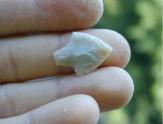 Otzi was carrying with him a quiver with arrows fourteen, twelve rods of Viburnum Lantana sketched with only the incision to the cusp, and two complete, but routes. One is entirely of Viburnum, the other is composite, with distal end of dogwood that is armed to the cusp. Some say that the addition of the extension rod served to recycle previously broken in the last 10 cm. Rather, I believe witnesses and techniques to create a two-stage missile, as is well known in ethnography, for the reasons mentioned earlier. These two have something else that distinguishes them: the helical fletching, insured auction with birch resin and reinforced with a coil of hair sheep, presents a right-handed, the other left-handed. This has assumed Arm Paulsen (the first archery equipment rebuilder of Otzi) that were produced by two different people, one right and one left-handed. Apparently the thing is flawless. Then one day I had a look at my arrows that I use to hunt, some of which made a long time ago I had no clear recollection, and I found the same thing. In an old goat-skin quiver of arrows were soaring along with spiral binding right, others left. Moral: it is completely irrelevant in the process of screwing the spiral binding, it just depends where you want to start to wrap, or if the nock from the other end. The same thing me the 'has confirmed Oscar Gonzalez, certainly more experienced than me in fact replicas of prehistoric arrows. However the fact remains that the two arrows may be the result of two different hands.
The peak in question, those found armed arrows in the quiver, are part of two rods broken in several places. Careful examination of the cracks do not seem the result of a fall (the other auctions are armed or not spikes intact, and the majority) but rather suggest arrows be "recovered" several times (the analysis of blood traces found up to 50 cm from the tip of the confirmation), then finally pull a target failure, and routes to work and to recycle valuable components. Could be arrows that have missed our flight, and he promptly recovered for reuse (Otzi had just finished material, but went with him all the tools needed to rebuild and assembly).
the cusp killer
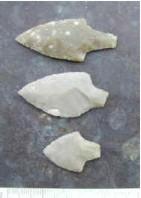 murderer of the arrow is not nothing (for now) that the small cusp of flint, measured by X-ray prof. Gostner in Bolzano and rebuilt virtually from the first Next tomography in three dimensions. Of course, x-rays pass through undisturbed organic material, it is not possible today to know if and how much organic material is connected to the cusp. From the image of my reconstruction you can see that it is really miserable: 2.1 cm long by 1.7 base.
forgot: reports interpreted by the amazing amount of archery accessories to suggest that Otzi was south of Alpine culture, because the arm cusps that the only two arrows in his quiver intact (if they are his and not collected during the flight) are belonging to 'cultural ensemble of the southern slopes of the Alps, then north Tyrolean peaks, then.
Moreover, even in the cusp shoulder, although shorter, is of the same type. It seems that the ancient Austria (Cultures of Cham and Altheim) prefers cusps base flat or slightly concave, without a central stalk. They, in the archaeological evidence, the vast majority. This characteristic, of cultural significance and not purely functional, differentiation and allows the classification of Otzi the bloody incident as the result of a fight between people of the south side of the Alps. On the other hand, the investigation of residues of food ingested by Otzi allowed with reasonable certainty to define the path taken by him, which began the beginning of the Venosta valley and went in the direction of the current Vernago artificial lake, then along the Tisental (Tisa valley) to the yoke of the Tisa, the "killing site" on the watershed between the tip el'Hauslabjoch Final, marking the border between north and south of the mountain ' Otzaler Alp.
This we can say with a good chance of Otzi the attackers were part of a cultural group "protoitalico. If the arrows in the quiver completed, that is, armed with leaflets, they were the property of ours, he may very likely be of the same ethnicity.
That said, the question remains on the small cusp. And here I summarize my uncertainties.
My goal today is to develop a predictive model that can help to interpret the accompanying ballistic (which are all that can be imagined) of those who hit our, set the standards for testing, do it, and wait for the data that may arise after the autopsy of the mummy to achieve a realistic result of comparison.
The fact is that the cusp is very poor. But still has penetrated 50 mm. tissue and broke through the left shoulder blade. And I do not know yet whether the impact has passed through tissue or other material, and the damage it has done anyway. the "cuspidina" is really very small, its weight close to 2 grams, similar in size and weight, for example, under certain cusp of Mali and Niger in the same period (see photo) and North African ones. The North African
cusps are characteristic of a particular cultural aspect of hunting with bows and methods are substantially different to those of alpine hunters, testified that the homogeneity of the findings, palaeoenvironmental studies which testify to the scarcity of wood to allow for the construction of high arches , cave paintings, etc.. The African Neolithic
uniform and in this respect is literally the case histories of its peak would still shoulder the size of that of Otzi among those with the greatest magnitude.
The North African Neolithic had weak arches, practiced the hunting of the big group game, and their killing was probably based on many arrows hitting the prey and weakened gradually.
Hence the question: strong bow and arrow from a "last chance" or bow girls, the "theory angry lover"?
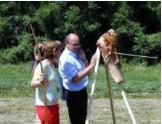 The first, discarding the African cultural assumptions, is that such cusp is the result of a corrective touch-up to allow its reuse, apparently executed immanicata cusp. In other words, the cusp part of an archery kit similar to that of Otzi and the powertrain is still "handsome." When I talk about a handsome outfit mean a set to allow bow-arrow hunting solo selective culling of ungulates, a kit and then meets the needs of a single hunter (or at least that hunting with a few other students) that enables low-medium distance shots and the factors conducive to the maximum detrimental, leading to a recovery of the wild ergonomic large. So far there's a wrinkle: I I would not dream of hunting big game with a strong arc less than 25 kg and with arrows lighter than those found in the quiver of Otzi. Why
last chance? Have been found in contexts also the oldest evidence of how, in emergency situations, the hunter "empty" his quiver against the target. If you like any good hunter worthy of respect, many arrows on his back door and between these there is dedicated to small game, in an extreme moment, having pulled his arrow quiver empty your best ... even with those of different vocations. In Denmark, at the Lake Vig, was found a beautiful rib of aurochs (Bos primigenius) Mesolithic arrowhead with a trapezoid (the classic transverse shearing, a trapezoid with the longer side that matches the profile of impact) stuck inside. It 's easy to imagine how that poor bison, already wounded by other arrows, about to defungere like a bull full of harpoons, has received even more in this arrow, also if not for him "in theory". The hunter has certainly drawn to him all the tirabile (I would have done so myself, hurt and angry with a buffalo in the water) not worrying about the "form" to think that evil in order (!) Would not do. Depending on your point of view ...
think that the cusp is the result of a "recovery" post earlier use comes from the fact that the size of the basis of its close proximity to other longer, the same period. Cusps "new" inscribed in a square-shaped (I mean the area of \u200b\u200b"live", ie without stem) I understand to be practically non-existent in burial contexts, where abound in those isosceles triangular area (width of base <>
General Bibliography:
Konrad Spindler, the iceman, translated by Joseph Cospito, Milan, New Practical Publishing 1998
Raffaele de Marinis, Joseph Bright, Otzi, the Iceman, Marsilio Editore, 1998
specification: Franco Rollo et al, Otzi Last Meals: DNA, Analysis of the intestinal content of the Neolithic Glacier Mummy from The Alps in "Proceedings of the National Academy of Sciences USA, 99, No.20, pp 12594-12599, October 1 2002
Various authors, the mummy of the Copper. New research on the Iceman, Proceedings of the international conference, Tyrol Museum of Archaeology, Bolzano, 1999
Paul Gostner, Eduard Egarter Vigl, insight: report of forensic Radiological Findings on the Iceman in "journal of Archaeological Science ", 29, No. 3, pp. 323-326, March 2002
James H. Dickson, Klaus Oeggl, Linda L. Handley, the return of Otzi, Le Scienze n.418 June 2003, pp.66-77 W. Oberhuber, Knapp R., 1997, The bow of the Tyrolean Iceman: a dendrocronological investigation by computed tomography. In S. Bortenschlager and K. Oeggl (eds): The Man in the Ice, vol. 4, pp. 63-67


